
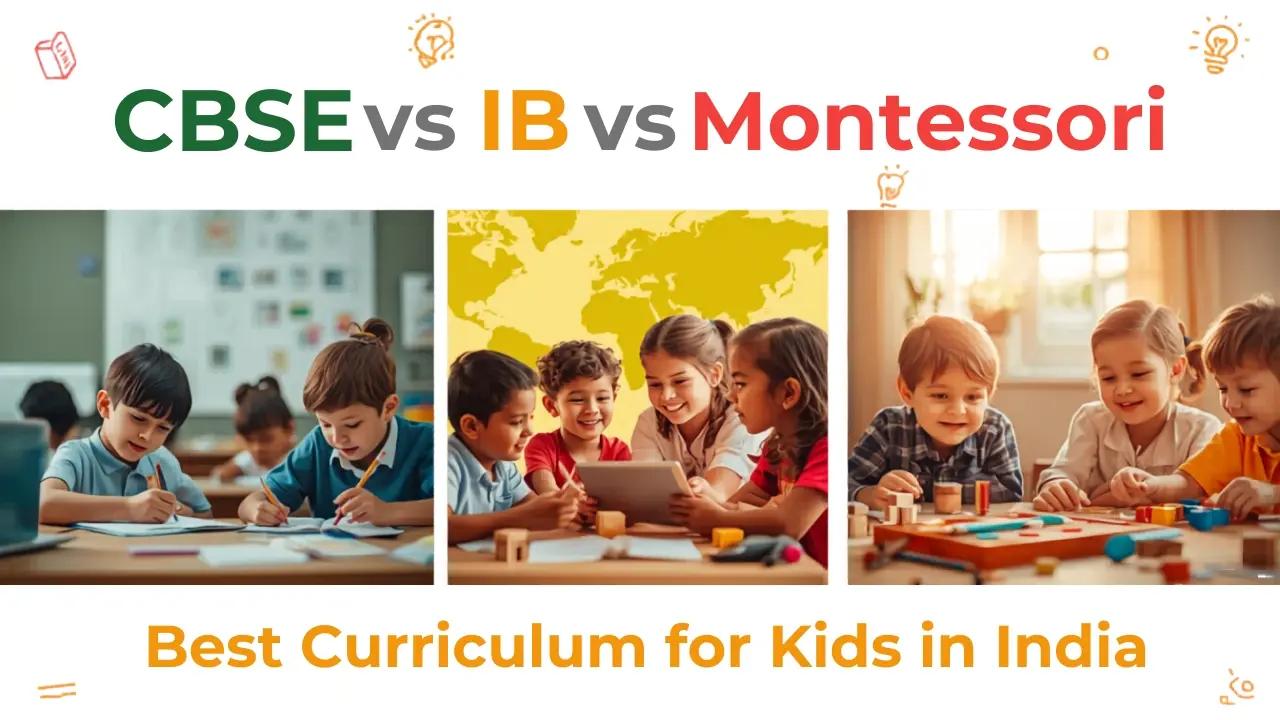
Choosing the right curriculum for your child is one of the most important decisions parents make. In India, three popular educational approaches, CBSE, IB, and Montessori, offer distinct philosophies, teaching methods, and outcomes. Understanding how each curriculum works can help you select the best fit based on your child’s learning style, future goals, and overall development.
Understanding the Importance of Curriculum Choice
A child’s early education shapes not just academic performance but also critical thinking, creativity, and social skills. The right curriculum supports holistic development by balancing knowledge, skills, and values. With evolving education trends, parents today look beyond textbooks and exams, focusing on experiential learning and real-world readiness.
CBSE Curriculum - Structured and Concept-Focused Learning
The Central Board of Secondary Education (CBSE) is one of the most widely followed curricula in India. It is known for its structured syllabus and strong emphasis on core subjects like Mathematics and Science.
CBSE focuses on conceptual clarity and prepares students for national-level competitive exams such as JEE and NEET. The curriculum is standardized across the country, making it easier for families who relocate frequently. Teaching methods are relatively traditional but are increasingly incorporating practical and application-based learning.
CBSE is ideal for students who thrive in a structured environment and aim for careers in engineering, medicine, or government services.
IB Curriculum - Global Perspective and Inquiry-Based Learning
The International Baccalaureate (IB) curriculum is globally recognized and focuses on developing well-rounded, internationally minded students. It emphasizes inquiry-based learning, critical thinking, and problem-solving.
IB encourages students to ask questions, explore concepts deeply, and connect learning to real-world contexts. It also places equal importance on academics, creativity, physical activity, and community service. The curriculum is flexible and promotes independent thinking rather than rote memorization.
IB is best suited for families seeking international exposure or planning higher education abroad. It nurtures confident, curious learners who are comfortable in diverse global environments.
Montessori Method - Child-Centered Early Learning Approach
The Montessori method is an early childhood education approach designed to foster independence, creativity, and self-paced learning. It is especially popular for preschool and primary years.
In Montessori classrooms, children learn through hands-on activities and self-directed exploration. Teachers act as guides rather than instructors, allowing children to choose activities based on their interests. This method focuses on developing life skills, sensory learning, and emotional intelligence.
Montessori is ideal for young children who benefit from a flexible, nurturing environment that encourages curiosity and independence. It builds a strong foundation for lifelong learning.
Key Differences Between CBSE, IB, and Montessori
Each curriculum offers unique advantages depending on the child’s needs and family priorities.
CBSE provides a structured and exam-oriented approach with a strong academic foundation. IB focuses on global exposure, critical thinking, and holistic development. Montessori emphasizes early childhood development through experiential and self-paced learning.
While CBSE and IB cater to primary through higher secondary education, Montessori is primarily focused on early years and often transitions into other curricula later.
How to Choose the Right Curriculum for Your Child
Selecting the best curriculum depends on several factors, including your child’s personality, learning style, and long-term goals.
If your child prefers structure, clear guidelines, and academic rigor, CBSE may be the right choice. If they are naturally curious, enjoy exploration, and benefit from interactive learning, IB could be a better fit. For younger children, Montessori offers a strong start by nurturing independence and foundational skills.
It’s also important to consider factors like school infrastructure, teaching quality, extracurricular opportunities, and alignment with future education plans.
Building a Strong Foundation for Lifelong Learning
There is no one-size-fits-all curriculum. Each child is unique, and the best choice is one that supports their individual growth and potential. A well-chosen curriculum not only ensures academic success but also helps children develop confidence, creativity, and critical life skills.
At leading schools and early learning centers across India, the focus is shifting toward creating balanced learning environments that combine the strengths of different educational approaches. By understanding the differences between CBSE, IB, and Montessori, parents can make informed decisions that set their children on the path to a successful and fulfilling future.
Choosing the Best Curriculum for Your Child’s Future
Every child learns differently, and the right curriculum can make a meaningful difference in how they grow and succeed. Whether it is the structured academic approach of CBSE, the global outlook of IB, or the child-centered philosophy of Montessori, each curriculum offers unique benefits that support different learning needs.
At Ieken Future School, the focus goes beyond academics to nurture every aspect of a child’s development. Through a thoughtful blend of structured learning, experiential activities, and personalized attention, children are encouraged to grow intellectually, socially, and emotionally. By creating an environment where learning is meaningful and engaging, the school helps every child build confidence, discover their strengths, and become future-ready learners.